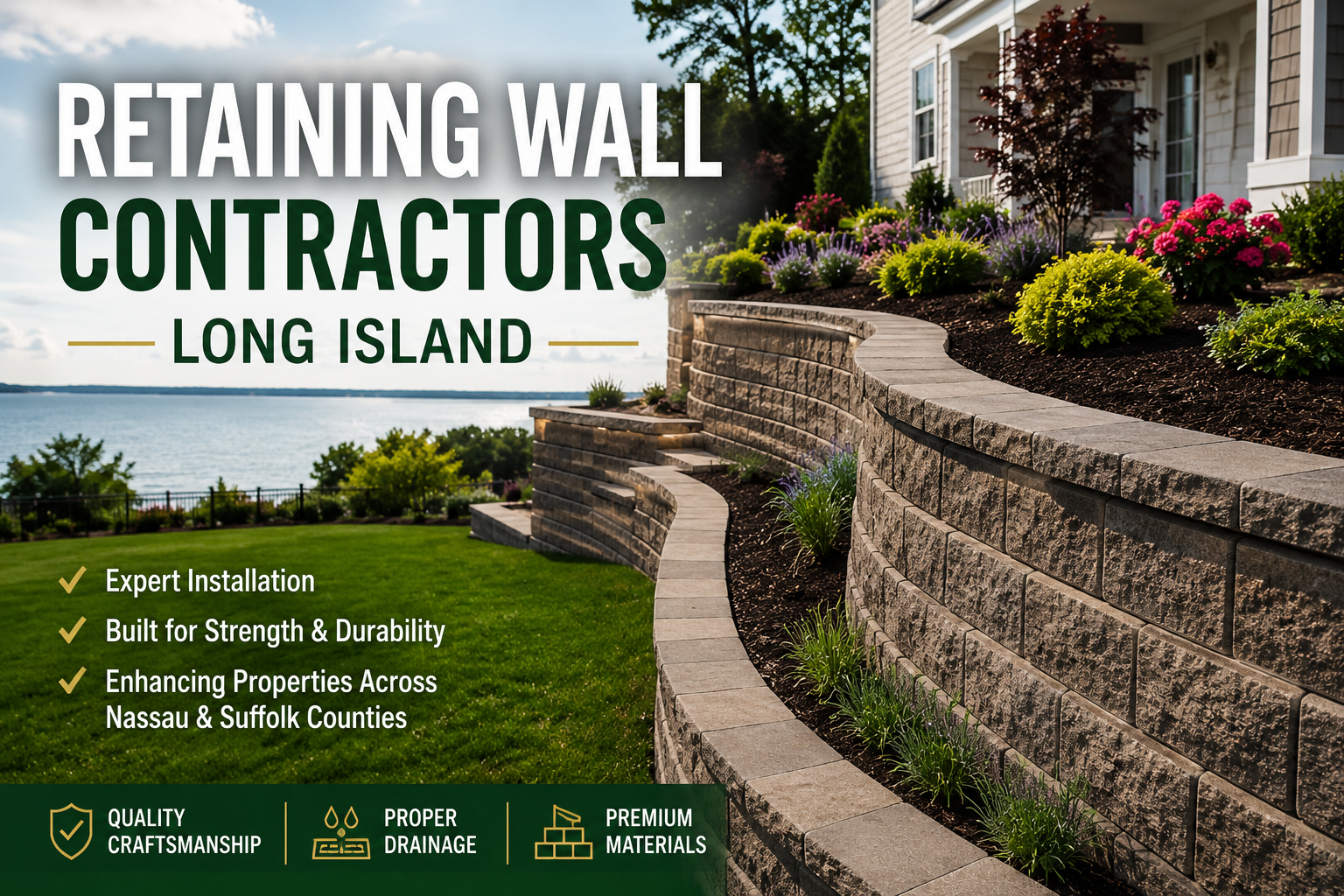
Retaining Wall Contractors Long Island
Request A Free Quote
A retaining wall does more than hold back soil. When it is designed and built correctly, it protects your property from erosion, manages elevation changes, improves drainage, and creates a cleaner, more usable outdoor space. For Long Island properties, where sandy soil, coastal moisture, heavy rain, freeze-thaw cycles, and sloped landscapes can all affect stability, a retaining wall should be built with both appearance and structure in mind.
McGowan provides retaining wall construction, masonry, and site improvement services for residential, commercial, and municipal properties across Long Island. Whether you need to replace a failing wall, stabilize a sloped area, create a cleaner landscape edge, or add structure around a driveway, walkway, patio, or parking area, our team can evaluate the site and recommend a durable wall system built for long-term performance.
What is a retaining wall?
A retaining wall is a structural wall designed to hold soil in place, control erosion, manage elevation changes, and create more usable outdoor space. On Long Island properties, retaining walls are often used near driveways, walkways, patios, landscaped areas, parking lots, and sloped yards where soil movement or drainage issues can cause damage over time.
Why Choose John McGowan & Sons for Concrete Foundations?
As a community-centered, veteran-owned business, McGowan 1928 takes pride in being more than just another asphalt contractor. They’ve built their reputation on trust, competitive pricing, and skilled technicians who complete every project with care. With nearly a century of expertise in sealcoating, asphalt paving, concrete repair, and masonry, they remain the go-to partner for property owners across New York — from Dutchess County and Putnam County to Long Island and Upstate New York.
Improved Safety
Resurfaced pavement eliminates tripping hazards, smooths potholes, and enhances visibility with new striping. It also minimizes water pooling and surface irregularities that can cause accidents. For commercial properties, proper parking lot striping and resurfacing create a more organized and compliant layout, especially in high-traffic work zones. When paired with noise reduction equipment and careful work zone safety planning, resurfacing projects contribute to an overall safer environment for both pedestrians and drivers.
Durability and Longevity
Using hot mix asphalt, asphalt paving techniques, and asphalt crack filler, resurfaced pavement can endure heavy vehicles, freeze-thaw cycles, and foot traffic. Incorporating recycled asphalt materials or permeable asphalt also supports long-term durability while improving sustainability. With proper asphalt maintenance, resurfacing protects against pothole repairs, crumbling sections, and degradation from rock salt or calcium magnesium acetate during winter. This makes it ideal for asphalt driveway repair, paving jobs, and full-scale commercial resurfacing.
Cost-Effectiveness
Compared to full replacement, resurfacing reduces the cost of asphalt repair significantly. Property owners can save 40–60% while achieving a refreshed, durable surface. The use of special machinery and efficient asphalt production processes makes resurfacing faster and more economical. Contractors like John McGowan & Sons, fully licensed & insured, provide professional asphalt solutions without compromising quality, ensuring long-term savings and increased property value for residential and commercial clients alike.

Long Island Retaining Wall Contractors for Residential and Commercial Properties
Every retaining wall has a job to do. Some walls support a raised landscape bed. Others hold back a slope, protect a driveway, frame an outdoor living area, or prevent soil from washing onto a walkway or parking lot. The right retaining wall depends on the property’s grade, soil conditions, drainage needs, wall height, surrounding hardscape, and the amount of pressure the wall must handle.
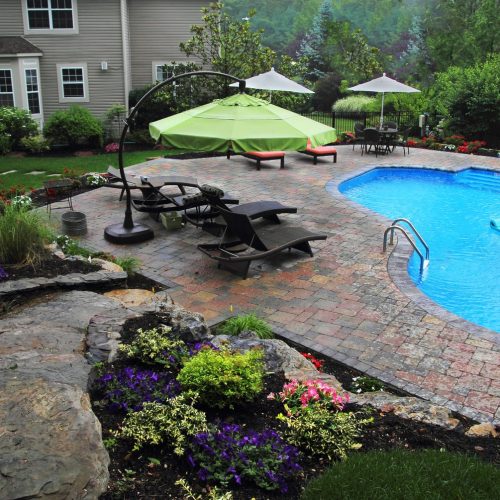
On residential properties, retaining walls can help homeowners level usable yard space, protect patios, border driveways, support garden areas, or create more defined outdoor living areas. On commercial properties, retaining walls may be needed around parking lots, sidewalks, loading areas, landscaped islands, access roads, ramps, and building entrances.
McGowan approaches each retaining wall project as part of the larger property. A wall should not only look finished; it should connect properly with the surrounding masonry, paving stone, concrete, asphalt, drainage system, and landscape features.
Retaining Wall Installation Built Around Drainage and Soil Conditions
Drainage is one of the most important parts of retaining wall installation. Many wall failures happen because water builds up behind the wall, adding pressure that the structure was not designed to handle. If water has nowhere to go, it can push against the wall, wash out soil, weaken the footing, and eventually cause bowing, leaning, cracking, or collapse.
A properly built retaining wall should include the right base preparation, drainage stone, filter fabric, backfill, and drainage pipe when needed. These components help move water away from the wall and reduce pressure behind the structure. For Long Island properties, this matters because spring rain, coastal storms, snowmelt, and freeze-thaw movement can all affect soil and wall stability.
Before construction begins, McGowan evaluates the slope, soil movement, existing water patterns, nearby hardscapes, and signs of erosion. This helps determine whether the project requires a simple landscape wall, a stronger load-bearing wall, drainage installation, masonry reconstruction, or a more complete site correction.
Types of Retaining Walls and Material Options
Retaining walls can be built with different materials depending on the style, budget, site conditions, and structural needs of the property. Common options include natural stone, concrete blocks, decorative retaining wall block, brick, wallstone, masonry units, and segmental wall systems. Each material has a different look, strength, maintenance requirement, and installation method.
Natural stone retaining walls offer a timeless appearance and can blend beautifully with Long Island landscapes, especially around older homes, gardens, patios, and traditional masonry features. Concrete block retaining walls are often used for strength, consistency, and clean design. Decorative wall blocks can provide a finished look while supporting soil and defining outdoor spaces.
For properties with patios, walkways, pavers, steps, or outdoor living areas, material selection should feel connected to the rest of the hardscape. Coping, color, texture, and wall height all affect the finished appearance. McGowan can help property owners choose a retaining wall design that balances durability, drainage, aesthetics, and practical use.
Signs You Need Retaining Wall Repair or Replacement
A retaining wall often gives warning signs before it fails. Leaning, bulging, cracking, separating blocks, loose stones, washed-out soil, standing water, and gaps near the base can all point to deeper problems. If the wall is holding back a slope, supporting a driveway, or protecting a walkway, those signs should not be ignored.
Water stains, erosion around the wall, soil pushing through joints, or movement after heavy rain may indicate that the drainage system is not working properly. In some cases, the wall may have been built without enough drainage stone, filter fabric, or proper backfill. In others, the footing may have shifted, the soil may be unstable, or the wall may not be strong enough for the load it is carrying.
Small repairs may be possible when damage is limited. However, if the wall is leaning, structurally compromised, or repeatedly failing, replacement may be the safer long-term option. McGowan can inspect the wall and determine whether repair, reinforcement, partial reconstruction, or full retaining wall replacement is needed.
Why Professional Retaining Wall Construction Matters
Retaining walls are not just decorative masonry. Even a wall that looks simple must be built to manage weight, water, soil movement, and weather exposure. Poor installation can lead to wall failure, drainage problems, erosion, cracked hardscapes, and costly reconstruction later.
Professional retaining wall contractors understand how to prepare the base, set proper footings, manage drainage, choose suitable materials, and build for long-term durability. This is especially important for taller walls, load-bearing walls, commercial properties, walls near pavement, and areas where water runoff is already a concern.
Hiring an experienced contractor also helps protect the rest of the property. A wall that is not properly tied into the surrounding grade can create new drainage problems. A wall built too close to a driveway, walkway, patio, or parking lot without proper planning may affect nearby surfaces. McGowan builds retaining walls with the full site in mind, so the finished project supports both function and curb appeal.
Schedule Retaining Wall Services on Long Island
If your property has soil erosion, a failing wall, uneven grades, drainage problems, or outdoor areas that need better structure, a retaining wall may be the right solution. McGowan provides retaining wall construction, repair, replacement, masonry work, and related site improvements for properties across Long Island, including Nassau County and Suffolk County.
Our team can evaluate your property, review drainage concerns, recommend the right wall system, and build a retaining wall that improves stability, appearance, and long-term use. From natural stone and concrete block retaining walls to masonry reconstruction and hardscape improvements, McGowan helps property owners create outdoor spaces that are safer, stronger, and better prepared for Long Island conditions.
Contact McGowan today to schedule an estimate for retaining wall services on Long Island.
See Why So Many Choose McGowan 1928

John and Jim,
I am writing this letter to let you know that I am moving on in a pursuit of a new opportunity and I wanted to express my gratitude for your support during my time with Konica.
By depending on the services of McGowan we were able to streamline our local services for a reasonable cost and at a critical economic juncture we maintained momentum and continuity. Thank you so much for all the great projects we were involved in together from the concrete work, asphalt paving work, retaining walls, drainage projects and many others. I cannot thank you enough for your quality work and helpful advice.
If you ever need a recommendation please do not hesitate to use my name. When construction projects come up in my new position I will be sure to call McGowan first.
Commercial Project
John, I wanted to thank you for taking the time to meet with me last week. I truly appreciated your creative ideas on how to significantly reduce some of the maintenance costs associated with our plant in Glen Head, NY.
It is the choice of vendors like McGowan that helped Halm Industries become a world leader in envelope printing equipment. While Halm Industries pursued global presence and success, McGowan helped maintain our local plant’s infrastructure seamlessly. Please accept our gratitude for the 28 years of reliable, on time and always within budget projects and we look forward to your continued support.
We will provide the management team with your ideas to reduce maintenance costs and get in touch soon.
Steve Lyon
P.S. I also wanted you to know that the retaining wall and drainage project completely solved the problem with the floods.
Commercial Project
“Dear Jim, John, and Company,
Today, as we continue the tradition of one of the most respected funeral homes on Long Island, we wanted to extend our appreciation for your continued support.
Specifically, the latest renovation project completed by John McGowan & Sons entirely resolved potential tripping accidents on our property. We cannot thank you enough for the perfect recommendation in the choice of the stone — it truly complements our entire atmosphere.
And as always, thank you for getting it all done on time and at very reasonable rates.
It is time to have our parking lot sealed, so please give us a call when you can schedule this job.”
Commercial Parking Lot Project
“I’m the President of an HOA in Bohemia, NY and a retired Union General Labor Foreman in NYC and on Long Island. Over my 40+ year career, I’ve worked with many contractors — and hands down, John McGowan & Sons is one of the best I’ve had the pleasure to work with.
They handled our complex’s street replacement project with absolute professionalism. From James, John, Eileen, and Jessica to the extraordinary group of hardworking men they employ — their professionalism, knowledge, experience, and courteous manner truly stood out.
This company will get your project done in a timely fashion and on schedule, no matter what it takes — and that’s exactly what I experienced.
If you want a great company to handle your project, no matter how small or large, you definitely want JOHN McGOWAN & SONS to do it!!!!”
HOA Road Improvement Project
“J. McGowan just completed a beautiful improvement on our small private lane on the North Shore of Long Island. The shared private road was in poor disrepair, and with McGowan’s expertise and easy lead time, the job came out gorgeous. All resident neighbors were very happy with the result.
The office staff was always responsive and considerate, and the workers on the job were polite and kept the job site neat and clean. The pricing was also very good compared to other bids we received.
I highly recommend this paving contractor.”
HOA Road Improvement Project
“John and his team did a great job replacing our old retaining wall, stairs, extending our front porch, and repaving our driveway at our home on the North Shore of Long Island.
John McGowan & Sons were recommended by a friend in the neighborhood after seeing the beautiful work they had done at their home. A job that I thought would take weeks was done in just 10 days — start to finish.
When we thought there might be an issue with an old tree being in the way, John had someone take it down the same day so his crew could keep working. When we suspected a potential problem with the water main, he had his plumber there immediately to ensure no damage would occur. And when our outdoor light stopped working, his electrician showed up within the hour to reconnect it.
They really went above and beyond to get the job done right, on time, and at the exact price quoted.
I highly recommend John McGowan & Sons to anyone looking for professional masonry work.”
Residential Project
“We recently had our driveway redone by McGowan & Sons, and the experience was excellent from start to finish. Jim and his team removed our old driveway and installed a brand new one — and it looks fantastic.
The whole process was smooth, quick, and professional. Jim kept us well informed at every step, which really made things easy. The crew was efficient, courteous, and clearly experienced.
The finished product is clean, polished, and exactly what we were hoping for. You can tell they take pride in doing a thorough job. We’re really happy with how it turned out and wouldn’t hesitate to recommend McGowan & Sons to anyone looking for quality driveway work.”
Residential Project
“Thought I would send you a thank you note for such a great job. The roads that you milled and paved came out great! I am getting rave reviews all around! All the homeowners are extremely satisfied.
And thanks for doing it at such reasonable rates. You made my job so much easier by giving personal attention to the homeowners.
We thank you for efficiently managing all your workflow and the traffic during renovation. I am definitely calling John McGowan & Sons for any outdoor construction or renovation work in the future.”
HOA Road Improvement Project
“Jim, I just wanted to take a minute to let you know how pleased we are with the new design layout and installation of the Belgium block curbs and the driveway. We love the expanded parking space!
Thank you for the personal attention and quality workmanship. This job is so impressively well done that it definitely improved the curb appeal and resale value of our property.”
Residential Project
“Hello John and Jimmy,
We thank you for the high-quality job done on the project for our tenants. All the residents are pleased with the upgrade to the roads that was recently done by John McGowan & Sons. Everybody really enjoys the new look, especially the Belgium block apron at the entrance to the street.
We had shopped around before choosing your company for the job, and I must say that we made the right choice. We were impressed with your daily updates on the project as it was finished within budget and on time!”
HOA Road Improvement Project
“John McGowan is a reliable, respectful company that performs impeccable, professional work. They are efficient, hardworking, and aim to please the customer.
J. McGowan’s work is top-notch, and I was also so pleased that at the completion of the work, everything was cleaned up and the masonry and driveway were perfect.
Communication between the company and their administrative office was honest, with all responses received in a very timely manner. His workers are friendly, courteous, and hardworking.
If you are thinking of using John McGowan — please do!!!! Thank you, John McGowan — we couldn’t be happier!!!”
Residential Project
“Very happy with the quality and professionalism. We will definitely do business again, and I highly recommend them!”
Positive: Responsiveness, Punctuality, Quality, Professionalism
Services: Asphalt paving & repair, Paving job site preparation
Commercial Parking Lot Project
“John McGowan & Sons did an outstanding job on our front walkway and patio. The team was always very timely and finished the job much earlier than we were initially quoted.
We were thrilled with their work, professionalism, and quality.”
Positive: Responsiveness, Punctuality, Quality, Professionalism
Services: Service not listed
Residential Project
“John McGowan did a great job in creating a beautiful driveway lined with Belgium blocks. Very professional. I was given a detailed estimate of the entire job.”
Positive: Professionalism
Services: Asphalt paving & repair
Residential Project
“We just had our driveway done — amazing job! Reliable, friendly, and timely. Would definitely recommend this company to anyone.”
Positive: Responsiveness, Punctuality, Quality, Professionalism, Value
Residential Project
“We worked with John McGowan & Sons to grade our backyard, put in a patio, and re-do the driveway. They were wonderful to work with, and the job came out better than expected. I highly recommend this company.”
Residential Project
“We had a great experience working with John McGowan & Sons for a complete repair of our rather long driveway. Jim McGowan went out of his way to keep us informed throughout the entire process, and his crew was very professional and great to work with.
The cost was also reasonable for their high-quality work.”
Residential Project
“This company just completed a pothole repair on our private road. They are a professional company that operates their business in a reliable and respectful manner. They do what they say and follow up well.
I would definitely use them again.”
HOA Road Improvement Project
“John McGowan & Sons did a great job for the Maidstone complex in Riverhead. We had 82 driveways and our community roads resurfaced.
Both Jim and John McGowan worked as a team to rapidly and successfully complete the project. A quality crew, quality materials, and attention to detail make this firm stand out.
Communication was done daily and helped prepare the community for the work ahead. They delivered what they promised.
A fine effort all around. Highly recommended.”
HOA Project
“Thank you again for such a great job on the driveway. You have an amazing staff. Mike was fantastic — he takes tremendous pride in the work he does.
Your staff was clean and neat. I would strongly recommend. Keep up the great work!”
Residential Project
“Very satisfied with the job from start to finish. The attention to detail and price point was unbeatable for a high-quality paving job.”
Residential Project