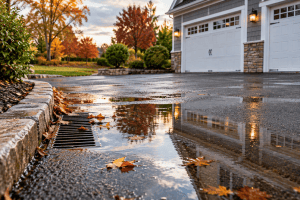
How to Fix Driveway Drainage Problems Before Fall and Winter Rain
Updated on:
September 22, 2026
Driveway drainage problems often become easier to notice during fall and winter because heavier rain, falling leaves, snowmelt, and freezing temperatures put more pressure on the surface and base. Standing water that seems minor during summer can move into cracks, wash material from beneath the driveway, or freeze when temperatures drop. That moisture can contribute to larger cracks, potholes, ruts, settlement, and premature pavement failure. For Long Island homeowners, fixing water flow before colder weather arrives can protect asphalt, concrete, pavers, and the surrounding property from avoidable seasonal damage.
The first step is understanding where the water comes from and where it goes. Rain may fall directly onto the driveway, flow from a sloped yard, discharge from roof downspouts, or collect in a low area created by poor grading. Because asphalt and concrete are impervious surfaces, most rainfall becomes surface runoff rather than soaking into the ground. The New York State Department of Environmental Conservation explains that stormwater flowing across paved surfaces can increase erosion and flooding when it is not slowed, captured, or directed properly. Fixing drainage therefore requires more than filling the puddle itself. The complete drainage route must be considered. NYSDEC stormwater guidance
Why Fix Driveway Drainage Problems Before Winter?
Poor drainage becomes more damaging when water repeatedly enters cracks and weak areas in a driveway. During colder weather, that moisture can freeze, expand, thaw, and enter the pavement again. Repeated freeze-thaw cycles place stress on asphalt, concrete, paver joints, and the base beneath the surface. The U.S. Geological Survey notes that freeze-thaw damage contributes to the formation of potholes in colder parts of the country, particularly during late winter and spring. A driveway with existing drainage problems enters that season with more moisture already sitting where it should not be. USGS information on freeze-thaw pavement damage
Water beneath the driveway can be just as important as standing water on top. If runoff continually reaches the same edge, crack, or low spot, it may soften or erode sections of the base. Traffic then places weight over material that no longer provides even support. The result may be depressions, ruts, cracking, loose pavers, or potholes. Once fall leaves and debris begin blocking existing drainage routes, the problem can get worse quickly. Correcting grading, clearing drainage systems, repairing pavement, and redirecting runoff before winter gives the driveway a better chance of handling rain, snowmelt, and freezing temperatures.

What Are the Warning Signs of Poor Driveway Drainage?
Standing water is the easiest warning sign to spot. After a storm, walk the property once the rain slows and look for puddles that remain in the same locations. Water collecting near the garage, foundation, driveway apron, retaining walls, or pavement edges can indicate that the surface flow is moving in the wrong direction. Dark wet areas that remain long after the rest of the driveway dries can also reveal low spots or drainage routes that are not working correctly.
Cracks, potholes, ruts, and sunken pavement provide additional clues. A crack that repeatedly holds moisture may allow water to reach the base. Gravel driveways can develop channels where runoff carries fresh gravel downhill or pushes it toward the road. Paver systems may show settlement or movement where the base has been affected. Concrete may develop cracking around areas where water repeatedly pools. These symptoms do not always have one cause, but when surface damage appears in the same places where water collects, the drainage system should be evaluated along with the pavement.
Look beyond the driveway itself as well. Soil washing away beside the pavement, mulch moving after storms, exposed roots, overflowing catch basins, saturated lawn areas, and water flowing from a downspout toward the driveway can all indicate a larger stormwater problem. NYSDEC notes that runoff from hard surfaces gains speed and can contribute to erosion and localized flooding. Identifying these patterns before repairs begin helps prevent a new driveway surface from developing the same problem later. NYSDEC drainage, runoff and flooding guidance
How Grading and Drainage Systems Control Water Flow
Proper grading uses the shape and slope of the property to move water toward an appropriate drainage route. A driveway should not unintentionally direct runoff toward a garage, building foundation, or area where water has nowhere to escape. Correcting the slope may require land grading, rebuilding part of the driveway base, raising a low area, or adjusting transitions between the driveway and surrounding property. The correct solution depends on elevation, soil conditions, pavement type, and where stormwater can safely discharge.
Grading alone may be enough when the problem is caused by a shallow depression or incorrect surface slope. More complicated properties may need a drainage system that collects water and carries it away from the problem area. John McGowan & Sons provides drainage and site work that includes grading, French drains, catch basins, excavation, and related property drainage solutions. These systems can be incorporated into driveway paving or existing properties when water needs a defined route instead of flowing uncontrolled across the surface. John McGowan & Sons drainage and site work
The goal is not simply to move water as quickly as possible. Drainage should move runoff to an appropriate location without creating erosion or sending a new water problem toward another part of the property. NYSDEC explains that poorly handled drainage can increase erosion, change runoff patterns, and contribute to flooding. A professional site evaluation considers the complete water flow pattern, including nearby slopes, paved surfaces, lawn areas, structures, and existing drainage routes.
French Drains, Channel Drains, and Catch Basins
Different drainage problems require different systems. A French drain typically uses a perforated pipe surrounded by stone to collect subsurface or surface moisture and redirect it. This can help where water saturates soil beside a driveway or repeatedly reaches the pavement base. Catch basins collect surface runoff at a low point and connect it to underground piping. They are often useful where a large amount of water concentrates in one predictable location.
Channel or trench drains are commonly installed across a driveway where surface water needs to be intercepted before reaching a garage, building, or another low area. Water enters the grated channel and is carried into an appropriate drainage route. Swales and other grading techniques may also redirect surface flow without requiring a drain across the pavement.
The correct system depends on the amount of runoff, slope, soil, driveway layout, and discharge location. Installing a drain without correcting the cause of the water can leave the property with the same drainage problem in a different location. That is why grading and drainage design should be considered together.
How Driveway Materials Affect Drainage and Winter Damage
Asphalt, concrete, pavers, and gravel driveways manage water differently. Traditional asphalt and concrete surfaces are largely impermeable, which means rain and snowmelt must move across the surface toward a drainage route. If the driveway has poor grading or a low spot, standing water can develop. Cracks and damaged joints then provide openings where moisture can enter. Crack repair, resurfacing, seal coating when appropriate, and drainage corrections can help prevent small pavement defects from turning into larger winter problems.
Paver systems depend heavily on the condition of the base and joints. If runoff washes material away beneath the surface, individual pavers may settle or become uneven. Gravel driveways require enough slope and a stable base to resist erosion and rutting. Routine grading may be necessary when traffic and stormwater create depressions or channels. Adding fresh gravel without fixing water flow may temporarily improve appearance but usually does not correct the underlying drainage problem.
Permeable pavers, porous asphalt, and pervious concrete offer another option for certain properties. Instead of sending all rainfall across the surface, permeable pavement allows water to enter spaces within the pavement and move into a stone storage layer below. The EPA identifies permeable pavement as a green infrastructure method that can store or infiltrate stormwater where it falls. The system must still be properly designed because soil conditions, base construction, maintenance, and drainage capacity affect performance. EPA guide to permeable pavement systems
Should You Repair, Resurface, or Replace the Driveway?
Drainage repair and pavement repair often need to happen together. If the driveway is structurally sound but has isolated cracks or a drainage problem beside the pavement, correcting water flow and completing targeted repairs may be enough. Sealants and crack filling can help limit moisture entry when defects are still manageable. However, sealing over cracks will not solve settlement, poor grading, or a failing base underneath the driveway.
Resurfacing may be appropriate when an asphalt driveway has widespread surface wear but the underlying base remains stable. A new asphalt layer can restore the driving surface, but drainage problems should be corrected first. Otherwise, standing water and base movement may damage the new surface. When the driveway has deep potholes, severe rutting, widespread settlement, major base failure, or an incorrect overall slope, replacement may allow paving crews to rebuild the base and establish better grading from the start.
A professional inspection should look at more than visible cracks. The driveway’s pitch, base condition, drainage routes, nearby structures, and areas of recurring standing water all help determine the right repair. John McGowan & Sons provides residential driveway paving and repair throughout Long Island, along with the drainage and site preparation needed to address problems below and around the pavement. John McGowan & Sons driveway paving services
How to Prepare Your Driveway for Fall and Winter Rain
Start fall preparation by watching what happens during a real rainstorm. Note where water enters the property, where it crosses the driveway, and where it finally collects. Clear leaves, soil, and debris from catch basins, drainage channels, driveway edges, and other water routes. Check downspouts to make sure they are not sending roof runoff directly onto a vulnerable section of pavement. Small maintenance steps can restore water flow when the drainage system itself is still functioning properly.
Next, inspect cracks, low spots, potholes, ruts, loose pavers, and eroded driveway edges. Problems that repeatedly hold moisture should receive priority before temperatures begin cycling below freezing. Asphalt crack repair, re-stabilizing gravel, resetting pavers, correcting grading, or resurfacing may be appropriate depending on the condition of the driveway. If water repeatedly approaches the garage or foundation, a drainage evaluation should happen before cosmetic pavement repairs.
Fall is also a good time to evaluate whether the existing drainage system can handle heavier storms and winter snowmelt. Long Island properties vary widely in slope, soil conditions, driveway size, and surrounding construction, so there is no single drainage solution that works everywhere. A property may need better grading, a catch basin, French drain, channel drain, permeable paving, or a combination of systems.
John McGowan & Sons provides driveway paving, drainage systems, grading, excavation, and site work across Nassau and Suffolk Counties. Addressing drainage before fall and winter gives homeowners the opportunity to control water before repeated rain and freeze-thaw cycles create larger pavement problems. The best solution protects both the driveway surface and the base beneath it, directing stormwater where it can be managed without damaging the surrounding property.
Recent Posts