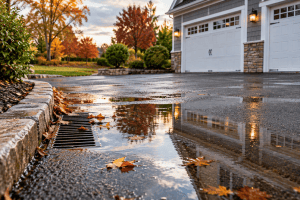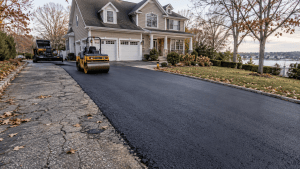
Water should move away from buildings, pavement, and outdoor living areas—not collect beside them. When puddles remain after rainfall, lawns stay saturated, or runoff repeatedly crosses a driveway, the property may need more than a temporary fix.
John McGowan & Sons provides professional drainage and site work for homes, businesses, and municipal properties throughout Long Island, NY. Our team evaluates how water enters, travels across, and leaves the site before recommending a solution built around the property.
Drainage Solutions for Nassau and Suffolk County Properties
Effective drainage begins with understanding the land. Long Island’s aquifer system contains layers of sand, gravel, silt, and clay, so water movement can vary significantly by location. The U.S. Geological Survey identifies these different materials throughout the regional aquifer system.
Roof runoff, compacted soil, low areas, and impervious surfaces such as patios, driveways, and parking lots can also affect drainage. Because stormwater may carry sediment and other pollutants, the New York State Department of Environmental Conservation emphasizes responsible runoff management.
A contractor should consider grading, soil conditions, discharge location, surrounding improvements, and local requirements before installation begins.
Signs Your Property Needs Professional Drainage Work
Drainage trouble is not limited to severe flooding. Common warning signs include:
- Standing water that remains long after rainfall
- Soil erosion or mulch washing away
- Water collecting near the foundation
- Soggy lawns and unhealthy landscaping
- Runoff flowing across a driveway, patio, or walkway
- Puddles or ice forming in parking areas
- Catch basins or drainage pipes that repeatedly clog
Ignoring these conditions can contribute to damaged pavement, unstable soil, unusable yard space, and moisture near a structure. A site evaluation helps identify the source instead of treating only the visible symptom.
Drainage Systems Designed for the Site
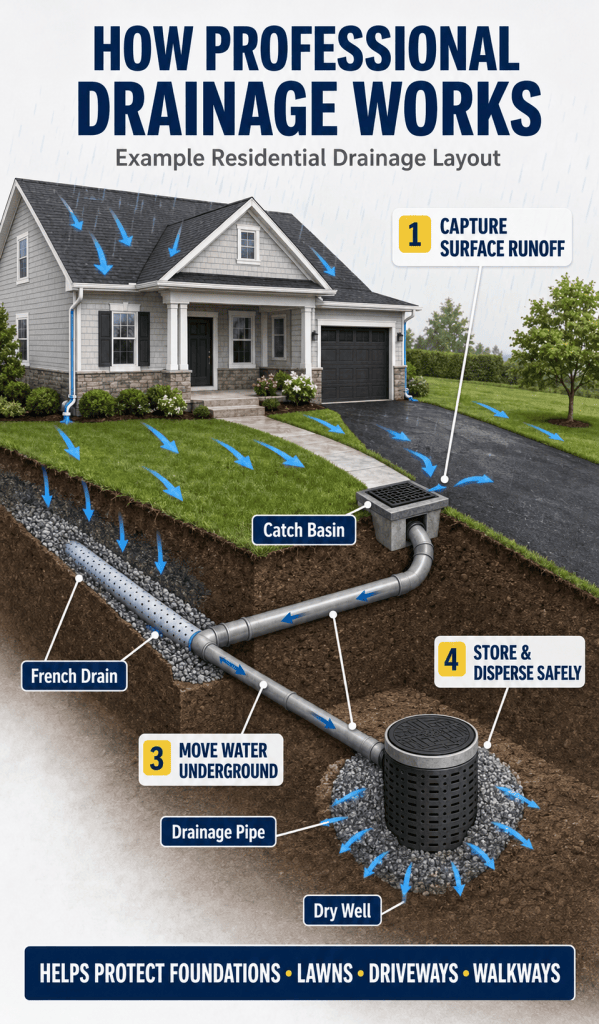
There is no single drainage system that works for every Long Island property. Depending on the elevation, soil, runoff volume, and available discharge area, a project may involve French drains, dry wells, catch basins, trench drains, underground drainage pipes, swales, or corrective grading.
For paved surfaces, proper pitch can direct water toward a collection point rather than allowing it to settle in low spots. Catch basins can collect runoff from driveways, roads, and parking lots before directing it into a connected system. French drains may help intercept subsurface water, while dry wells can store runoff and allow controlled infiltration where site conditions permit.
McGowan also performs the excavation, utility trenching, grading, and site preparation needed to integrate drainage with driveways, patios, commercial lots, and broader site-development work. Explore our complete drainage and site work services.
Why Choose John McGowan & Sons?
Since 1928, John McGowan & Sons has served residential, commercial, and municipal clients across Nassau County and Suffolk County. Our company-owned equipment and experienced crews allow us to coordinate excavation, grading, drainage, paving, and concrete work without losing sight of how each part affects the finished property.
We begin by assessing the problem and developing a practical plan. Whether the project requires a new system, drainage repair, or improvements alongside new construction, our goal is to create dependable water management that supports long-term performance.
Contact John McGowan & Sons to request a property evaluation and free estimate.
Frequently Asked Questions About Drainage Contractors
What is a drainage contractor?
A drainage contractor evaluates unwanted water movement and installs systems that collect, redirect, store, or infiltrate runoff. The work may include excavation, grading, drainage pipes, catch basins, French drains, and dry wells.
How much does a drainage contractor cost?
Cost depends on the drainage problem, excavation depth, system type, materials, accessibility, and restoration required. An on-site evaluation is the most reliable way to price the complete scope.
What is the cheapest drainage method?
Minor grading corrections or a shallow swale may cost less than an underground system, but only when those methods suit the site. Installing the cheapest option without identifying the cause can lead to repeated repairs.
How much does new drainage cost?
A small residential correction and a commercial stormwater system have very different requirements. System capacity, trenching, disposal, permits, and connections all affect the estimate.
Recent Posts